
Stock trading through a proprietary trading firm can mean very different things depending on the account you choose. One provider may offer access to thousands of individual US stocks and exchange-traded funds, while another lets traders speculate on share prices through contracts for difference (CFDs). A third may offer index futures, which track a stock market benchmark rather than an individual company’s shares.
These differences influence much more than the instruments displayed in a trading platform. They affect trading hours, short-selling availability, leverage, overnight exposure, commissions, and the way risk limits interact with volatile market moves.
For traders who want to focus on equities, choosing a prop firm starts with a simple question: what exactly will you be trading? Once the instrument is clear, it becomes easier to compare access, platform functionality, evaluation rules, and the conditions attached to a funded account.
Five Prop Firms Compared by Stock-Market Access
The firms below represent different approaches to equity trading. The ranking is an editorial comparison of their relevance to stock traders, not a guarantee of performance, payout approval, or suitability for every strategy.
| Rank | Prop Firm | Stock-Market Access | Best Fit |
|---|---|---|---|
| 1 | Trade The Pool | Individual US stocks and ETFs | Traders focused on equities, including intraday and swing strategies |
| 2 | The Trading Pit | Dedicated stock challenge with real-equity exposure in a simulated environment | Traders seeking a stock-specific evaluation |
| 3 | Leofins | Stock CFDs within its broader CFD offering | Traders combining individual stocks with forex, indices, and other CFDs |
| 4 | FundedNext | 20 stock CFD symbols covering US and European equities | Traders who want selected shares alongside other CFD markets |
| 5 | FTMO | Stock CFDs among its wider range of tradable instruments | Multi-asset traders who want equity-price exposure within an established evaluation structure |
The distinction between real equities and CFDs is especially important. A CFD tracks a share’s price but does not give the trader ownership of the underlying stock. The firm’s terminology, contractual terms, and account structure should always be checked before purchasing a challenge.
1. Trade The Pool: Built Around Individual Stocks
Trade The Pool is a natural starting point for traders whose strategies revolve around individual equities rather than currency pairs or index derivatives.
The company advertises access to more than 12,000 stocks and ETFs. Its offering includes US-listed companies, smaller-cap shares, and penny stocks, subject to the applicable symbol list and trading restrictions. Traders can choose between day-trading and swing-trading approaches, while certain account configurations permit exposure outside regular market hours.
The evaluation stage uses a simulated trading environment intended to reflect real market conditions. Trade The Pool describes its funded stage as potentially operating through a live account or a simulator, depending on its risk department’s decisions and applicable conditions. Therefore, access to real-share instruments should not automatically be interpreted as a guarantee that every funded trade will execute in a live account.
What matters for stock traders
The range of available tickers can be useful for traders who specialize in particular sectors, earnings reactions, small-cap momentum, or individual company setups. Short-selling access can also matter, especially for traders whose strategies depend on weakness in overextended shares.
However, broad symbol availability does not mean that every ticker has identical liquidity or trading conditions. Less-liquid stocks can have wider spreads, rapid price changes, and more difficult execution. Restrictions can also differ between the evaluation and funded stages.
Before purchasing a program, review the permitted position sizes, exposure limits, minimum holding requirements, short-selling rules, and any restrictions around earnings announcements. Traders who hold positions beyond the regular session should pay particular attention to overnight exposure limits and the order types available during extended hours.
Trade The Pool is most relevant to traders who want a dedicated equity environment rather than a multi-asset CFD account.
2. The Trading Pit: A Dedicated Stocks Challenge
The Trading Pit offers a Stocks Challenge alongside its CFD and futures products. This makes it an option for traders who want to compare an equity-specific evaluation with other types of proprietary trading programs.
Its published stock offering provides access to real equities within a simulated trading environment. The firm has also announced access to individual names such as SpaceX under its stock program. Traders should distinguish the underlying market instrument from the execution environment: a challenge can reference real stocks and market conditions while the evaluation itself remains simulated.
The Trading Pit’s broader product range is useful for understanding how different market structures affect a trading approach. Nevertheless, a stock challenge should be assessed on its own rules rather than assumed to work like one of the firm’s futures or CFD programs.
The rules worth investigating
Stock traders should look closely at the buying power available for each plan, maximum position exposure, daily loss limits, and the conditions for holding or closing positions. A program may also impose restrictions around market close or require positions to be flattened before a specified time.
These details can materially affect strategy design. A trader who relies on late-session entries, for example, needs to know whether positions must be closed before the end of the trading day. Someone who trades volatile small-cap stocks should understand whether concentration limits or per-position restrictions reduce the size of a potential trade.
Also check the platform, data access, evaluation objectives, and reward agreement before choosing a challenge. Stock-specific rules should take priority over assumptions based on another account type offered by the same provider.
The Trading Pit is worth examining for traders who prefer an equity-focused challenge while retaining the option to compare other market categories under the same broader brand.
3. Leofins: Stock CFDs Within a Multi-Asset Environment
Leofins takes a different route. Rather than positioning its CFD program solely around individual shares, it offers stock CFDs as part of a wider selection of instruments that also includes forex, indices, cryptocurrencies, metals, energies, and other markets.
This structure can appeal to traders who use individual company prices for certain setups but also trade broader market conditions. For instance, a trader might follow a technology stock while monitoring a major equity index or currency market for context. A multi-asset account can make that workflow more convenient, provided the trader understands the differences between the instruments.
Stock CFDs are derivatives that track the price movement of a share. They do not provide direct ownership of that company’s stock, and the contract’s trading costs and financing arrangements may differ from those associated with holding shares through a conventional brokerage account.
Evaluation paths and risk controls
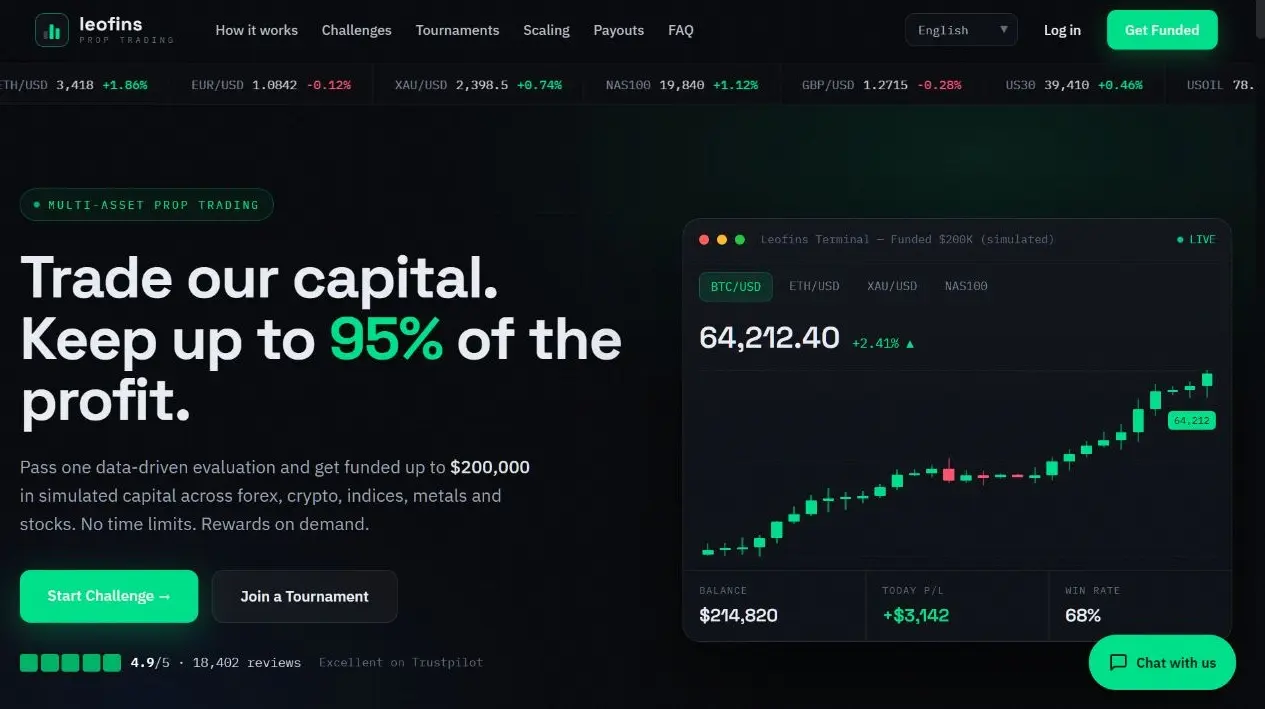 Leofins offers three main CFD evaluation paths: Core 2-Step, Edge 1-Step, and Starter 3-Step. These differ in their evaluation structure and risk parameters, so traders should choose the model based on its full rules rather than the number of stages alone.
The published programs include daily and maximum loss limits, with the applicable thresholds varying by model. These controls remain important when trading shares because individual stocks can experience sharp price gaps after earnings announcements, corporate news, or unexpected market developments.
Leofins also provides access to multiple trading platforms, including MetaTrader 4, MetaTrader 5, cTrader, TradingView, DXtrade, and Match-Trader, subject to the current program and platform availability. Before buying a challenge, verify that the selected platform supports the instruments and order functions required by your strategy.
Another point to check is whether stock-specific trading conditions differ from those applied to forex or indices. Confirm the available symbols, spreads, commissions, leverage, overnight costs, and any restrictions around news events.
Current program information is available at leofins.com/.
Leofins is best considered by traders who want stock-price exposure within a broader CFD setup, rather than those specifically seeking ownership of individual shares.
4. FundedNext: A Selected List of US and European Stocks
FundedNext offers stock CFDs within its CFD account range. Its published instrument list contains 20 stock symbols: 14 US equities and six European equities. This includes recognizable companies across areas such as technology, semiconductors, automotive, consumer products, and entertainment.
Compared with an equity-specialist provider offering thousands of symbols, this is a more selective universe. That may be sufficient for a trader who focuses on a small watchlist of liquid, well-known companies. It is less suitable for someone whose strategy depends on finding unusual opportunities across hundreds of small-cap stocks.
FundedNext’s published stock CFD conditions specify global leverage of 1:2 and a commission of 0.004% per lot. Spreads and swap charges also affect the overall cost of holding a position. The firm states that its stock CFDs are available across active CFD models and supported platforms, with platform access for US clients subject to specific arrangements.
How its rules affect a stock strategy
FundedNext applies its existing account risk framework to stock positions. Daily loss limits, maximum loss limits, and applicable consistency requirements continue to matter when a trader moves from forex or indices to individual stocks.
This means stock access does not create a separate risk allowance. A large adverse move in one share can consume a meaningful part of the account’s permitted loss, even if the trader is accustomed to managing several smaller forex positions.
The limited instrument list also makes symbol verification important. Check that every stock in your intended watchlist is supported, and review its contract specifications before placing a trade. Commission, leverage, and swap costs should be incorporated into position sizing rather than treated as minor details.
FundedNext may suit traders who want a familiar multi-asset CFD structure with a defined selection of individual shares.
5. FTMO: Equity Exposure Alongside Other Markets
FTMO includes stocks among the asset classes available through its trading environment, alongside forex, indices, commodities, and cryptocurrencies. Its stock exposure is provided through CFDs rather than direct ownership of the underlying shares.
This makes FTMO a different proposition from a stock-specialist program. Traders can use individual company prices within a broader multi-asset approach, but they should not assume that the firm’s full range of forex and index instruments has identical trading conditions to its stock CFDs.
The available symbols and specifications are published through the firm’s instrument information and trading platform. Availability, leverage, session times, and other conditions should be verified for the particular account and platform.
Where traders should pay attention
FTMO emphasizes that its challenge and account trading takes place in a simulated environment. The firm states that trading must follow its prohibited-practice rules and reflect legitimate market behavior. Its platform rules also set operational limits that can matter to automated systems and strategies generating frequent orders.
For stock traders, the first step is to verify which individual shares are listed and when they can be traded. The next is to check the account’s loss limits, restrictions around market sessions, and whether the intended strategy is permitted under the firm’s rules.
A trader using a strategy built around earnings gaps or short-lived price spikes should be especially careful. Stock CFDs can behave differently from forex pairs because of company-specific announcements, gaps between sessions, and changes in liquidity. A strategy that works on one instrument cannot automatically be transferred to another without testing its costs and risk characteristics.
FTMO is worth considering for traders who want stock CFDs as one component of a broader multi-asset evaluation, rather than a program centered exclusively on equities.
Stock Trading Is Not the Same as Trading Index Futures
A common mistake is to treat every instrument connected to the stock market as interchangeable. They are not.
An individual stock represents exposure to a particular company. A stock CFD tracks the price of a share without transferring ownership. An equity-index future, meanwhile, tracks a benchmark such as the S&P 500 or Nasdaq-100 and is traded under futures contract specifications.
These instruments can react to the same market news but behave differently at the position level. A company may fall sharply after disappointing earnings while the broader index rises. A futures contract also has its own tick value, expiration cycle, margin requirements, and trading schedule.
For this reason, futures-focused firms such as Topstep should not be described as offering individual stock trading merely because they provide access to Nasdaq or S&P 500 futures. Traders seeking individual company shares or share CFDs should confirm that the specific instruments appear in the firm’s permitted symbol list.
A Practical Framework for Comparing Stock Prop Firms
Rather than choosing a firm based on its advertised account size, evaluate the complete trading environment against your strategy.
| Trading Requirement | What to Verify | Why It Matters |
|---|---|---|
| Instrument type | Real shares, stock CFDs, or index futures | Determines the exposure and contractual structure |
| Market coverage | Available tickers, exchanges, and ETFs | Establishes whether your watchlist is tradable |
| Trading hours | Regular session, pre-market, after-hours, and overnight rules | Affects entry timing and position management |
| Short selling | Eligible symbols, restrictions, and exposure limits | Determines whether bearish strategies are practical |
| Position costs | Spreads, commissions, swaps, and other charges | Influences the profitability of frequent or overnight trades |
| Risk framework | Daily loss, maximum loss, position limits, and consistency conditions | Determines how much adverse movement the account can tolerate |
| Platform | Order types, charting, execution tools, and data | Affects how effectively the strategy can be implemented |
| Funded-stage conditions | Whether execution is simulated or live and how rewards are calculated | Clarifies what the trader receives after passing the evaluation |
The most important step is to evaluate these factors together. A large stock universe is of little value if your preferred tickers are restricted. Low commissions may not compensate for a platform that lacks the order functionality you need. Likewise, a favorable evaluation target does not make a challenge suitable if its drawdown model conflicts with the volatility of the stocks you trade.
Common Rules That Stock Traders Should Not Overlook
Earnings and corporate announcements
Individual stocks can move sharply after earnings releases, regulatory announcements, or unexpected company news. Check whether the firm restricts trading during these events or applies special rules to holding positions through announcements.
Overnight and extended-hours exposure
A position held outside regular market hours can face lower liquidity and larger gaps. Some programs permit extended-hours trading but limit exposure or restrict the available order types. Confirm the actual rules before planning a strategy around pre-market or after-hours moves.
Short selling and low-liquidity shares
Not every provider offers the same short-selling access. Some may restrict certain tickers, position sizes, or instruments during the funded stage. Thinly traded shares can also produce slippage and sharp price movements, so broad symbol availability should not be confused with unrestricted execution.
Drawdown calculations
A daily loss limit and a maximum account loss are not the same thing. Learn whether each limit is calculated using balance, equity, starting balance, or another reference point, and whether open-position losses count toward it. This is particularly important for stocks that can gap through planned stop levels.
Simulated accounts and reward agreements
Many retail prop programs use simulated accounts during evaluation and may continue to use simulation in the funded stage. A displayed account balance does not necessarily represent cash deposited in a brokerage account in the trader’s name. Read the firm’s agreement to understand how rewards are determined and what conditions apply to payment.
Frequently Asked Questions
Which prop firm is best for individual stock trading?
The best fit depends on the instrument and strategy. Trade The Pool is focused on individual US stocks and ETFs, while The Trading Pit offers a dedicated stock challenge. Leofins, FundedNext, and FTMO provide stock CFDs within broader multi-asset offerings.
Can I trade real stocks through a prop firm?
Some providers offer programs based on real-equity instruments, but the evaluation may still be simulated and the funded stage may also use simulation. Confirm the exact account agreement and execution arrangement before assuming trades are placed in a live market.
What is the difference between a stock CFD and a real share?
A real share represents ownership in a company, subject to the rights attached to that share. A stock CFD is a derivative whose value follows the share price. It provides price exposure but does not grant ownership of the underlying stock.
Can I hold stock positions overnight?
That depends on the firm, instrument, and program. Some equity challenges allow swing trading or overnight exposure, while others impose position-closing requirements or exposure limits. Check the rules for your exact account type.
Are stock prop challenges suitable for beginners?
They can be suitable for traders who understand the instruments and can follow the firm’s risk rules, but individual stocks introduce company-specific risks and potential price gaps. Beginners should learn the difference between shares, CFDs, and futures before paying for an evaluation.
Do stock prop firms guarantee payouts after a successful challenge?
No. Passing an evaluation does not guarantee a particular income or reward. Eligibility and payment depend on the firm’s agreement, trading-rule compliance, account status, and applicable payout conditions.
Choose the Market Structure Before Choosing the Challenge
Stock-focused prop trading is not a single category. Equity-specialist firms offer a different experience from CFD providers, and neither should be confused with firms that focus on index futures. The right choice begins with the actual instrument, followed by the rules that govern its use.
Trade The Pool and The Trading Pit are relevant starting points for traders looking for dedicated stock programs. Leofins, FundedNext, and FTMO offer alternatives for traders who want stock-price exposure within a broader CFD environment. Each requires a closer review of symbols, costs, trading sessions, risk limits, and funded-stage terms.
Before purchasing a challenge, compare the exact account rules against the strategy you intend to trade. A program is useful only when its markets, execution conditions, and risk framework support your approach without forcing you to rely on assumptions about what the account allows.
Prices and conditions are current as of October 2026.
Risk disclaimer: Proprietary trading evaluations involve financial risk. Challenge fees may be lost if an evaluation is unsuccessful or program rules are breached. Simulated trading and funded-program results do not guarantee future performance or income. Review the current terms carefully and never spend money you cannot afford to lose.
Інформація про автора